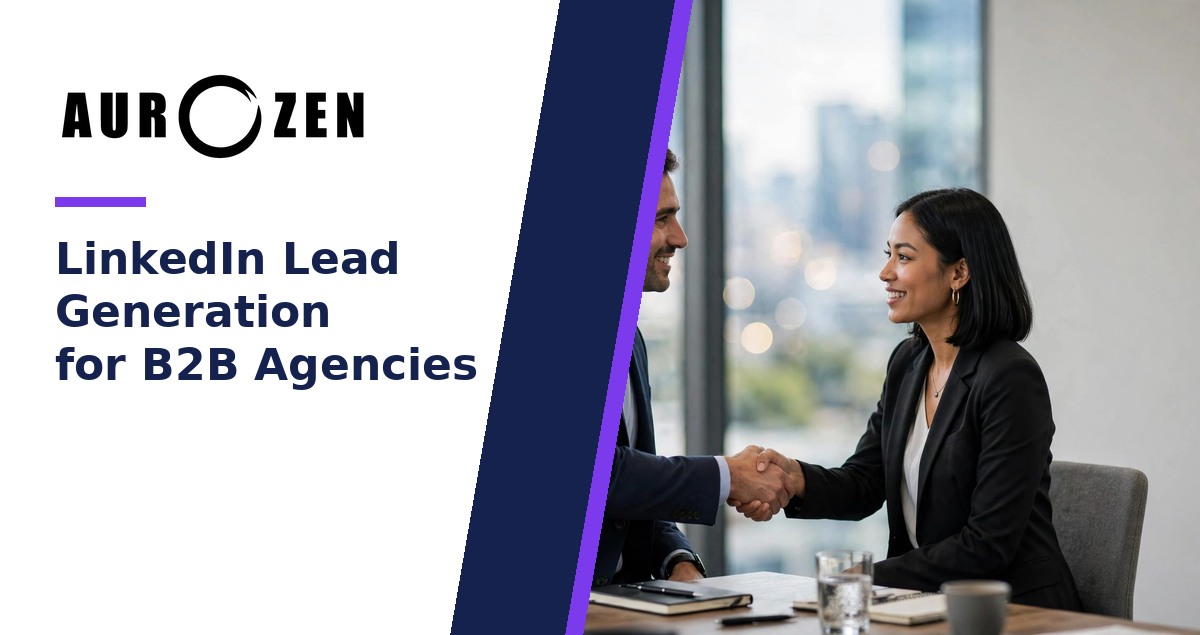
LinkedIn Lead Generation for B2B Agencies: The Playbook That Actually Fills Your Pipeline
If you run a B2B agency and you’re still treating LinkedIn as a digital résumé, you’re sitting on your best lead generation channel without realizing it. Here’s the short version: LinkedIn outperforms cold email for agencies because decision-makers actually read it, trust it, and respond to it — but only if your profile converts views into calls, your content speaks to buyers instead of peers, and your outreach is genuinely personal. This playbook walks you through all three, plus the follow-up cadence and metrics that turn conversations into signed retainers.
Why LinkedIn Beats Cold Email for Agencies
Let’s be honest about cold email in 2026. Deliverability is harder than ever, spam filters are ruthless, and most decision-makers have trained themselves to ignore anything from an unknown sender. Open rates on cold B2B email typically hover in the low double digits, and reply rates of 1–2% are considered decent. You can buy a list of 10,000 contacts and end up with twelve conversations, three of which are “take me off your list.”
LinkedIn flips that dynamic. When your message lands in someone’s inbox there, it arrives with your face, your title, your mutual connections, and your recent posts attached. That’s a massive trust shortcut. A prospect who would delete a cold email in two seconds will often read a LinkedIn message simply because it came from a person they can check out in one click.
The second advantage is intent. Nobody scrolls LinkedIn the way they scroll Instagram. People are there in a business mindset — thinking about growth, vendors, hiring, and partnerships. When you show up with something relevant in that context, you’re not interrupting; you’re contributing. That’s the whole difference between outreach that annoys and outreach that converts.
None of this means you abandon email entirely. It means LinkedIn becomes your front door: first touch happens there, the relationship builds there, and email becomes the follow-up channel once the conversation exists.
Profile Optimization: Turn Views Into Calls
Your profile is a landing page, and most agency owners treat it like a CV. That’s the single biggest mistake. A prospect doesn’t care where you worked in 2016. They care whether you can fix their problem. So every element of your profile should answer one question: why should this person book a call with you?
The Headline
Your headline gets more eyeballs than anything else on LinkedIn. “CEO at Aurozen Marketing” tells the reader nothing. Try a headline that states who you help and what changes:
We help B2B companies generate qualified leads with SEO, paid media & marketing automation | 40+ clients served
Notice what it does: names the audience, names the outcome, names the services, adds proof. Anyone reading it knows instantly whether they’re the right fit.
The Banner Image
The default banner is a wasted billboard. Replace it with a simple branded graphic that restates your offer: your agency name, a one-line value proposition, and a call to action like “Book a free strategy call.” Keep it clean — navy or dark background, white text, nothing fancy. It takes twenty minutes in Canva and it works forever.
The About Section
Write it in first person, lead with the prospect’s pain, and end with a clear next step. A structure that works:
- Hook: “Most agencies promise leads. Few deliver them consistently.”
- What you do: two to three sentences on your services and who they’re for.
- Proof: one or two specific results (“helped a SaaS client triple demo bookings in six months”).
- Call to action: exactly how to reach you — a link, an email, a Calendly booking page.
Skip the buzzwords. Write like you’d talk to a founder over coffee.
Featured Section
Pin your three strongest assets here: a case study PDF, a link to your booking page, and your best-performing post or article. When someone lands on your profile after reading a great post, this section catches them before they click away.
Experience and Skills
Rewrite your current role’s description as an offer, not a job description. Instead of “Responsible for client acquisition and team management,” write “We help B2B companies turn LinkedIn, SEO, and paid media into predictable pipeline. Current focus: retainer clients in SaaS and professional services.” Get a handful of skills endorsements for your core services — it’s a small trust signal, but it adds up.
Content That Attracts Decision-Makers
Here’s where most agencies go wrong: they create content for other marketers. Hot takes on algorithm changes, debates about attribution models, industry gossip — that gets engagement from peers and zero clients. Your audience is the founder, the CMO, the VP of Sales. They don’t care about your opinions on marketing theory. They care about money in, money out.
What to Post
Post about the problems your prospects wake up thinking about:
- Teardowns and audits. Take a real company (anonymized if needed) and show what you’d fix about their funnel, ads, or website. Decision-makers read these like horoscopes — “is that us?”
- Client results with numbers. “We cut this client’s cost per qualified lead from $180 to $74 in 90 days. Here’s exactly what we changed.” Specificity is what separates content that books calls from content that gets likes.
- Process posts. Walk through how you do something: “Our exact 14-day LinkedIn outreach sequence for new clients.” Founders love process because it proves you have a method, not just motivation.
- Mistake posts. “The three reasons your last agency engagement failed — and it wasn’t their fault.” Contrarian, honest content earns attention fast.
Format and Cadence
Three to five posts a week is the sweet spot for most agency owners. Mix formats: text-only posts still perform well for insights, carousels work for step-by-step content, and short video or talking-head clips are increasingly effective because so few founders bother making them.
One practical rule: write the first two lines of every post like a newspaper headline. On LinkedIn, only the first two lines show before the “see more” cut — that’s your real hook. If those lines don’t create curiosity, the rest of the post doesn’t exist.
Engage Like a Human, Not a Brand
Spend fifteen minutes a day commenting on posts by your ideal prospects. Not “Great insight!” — actual comments that add something: a question, a related experience, a data point. Prospects notice who shows up in their notifications. By the time your connection request arrives, you’re already a familiar name, not a stranger. That familiarity doubles your acceptance and reply rates without any extra tools.
Outbound Outreach That Gets Replies
Even with great content, agencies that wait for inbound alone grow slowly. Outbound on LinkedIn works — but only the kind that reads like it was written by a person who did their homework.
Build a Tight Target List
Don’t spray 100 connection requests a day at anyone with “CEO” in their title. Define your ideal client narrowly: industry, company size, geography, and ideally a trigger — recent funding, a new hire in marketing, a product launch, a job post for a marketing role (which means they’re spending but possibly struggling). LinkedIn’s free search filters plus these triggers give you a list of 200–300 high-fit prospects per month. Quality over quantity is not a slogan here; it’s the whole strategy.
The Connection Request
Always include a note, and make it about them, not you. The formula is simple: one specific observation + a low-pressure reason to connect.
“Saw your team just launched the new onboarding flow — impressive growth on the SaaS side. I share teardowns of B2B funnels and lead gen experiments here; figured it’d be relevant. Happy to connect.”
No pitch. No “I’d love to introduce our services.” You’re asking for a connection, not a marriage. Keep it under 300 characters.
The Follow-Up Sequence
Most replies come from follow-ups, not first messages. The mistake is making follow-ups sound like nagging. Here’s a sequence that works:
- Day 1 (after acceptance): A short thank-you plus one piece of value — a relevant post, a quick observation about their company, or a useful resource. No ask.
- Day 4: Share something specific to their situation. “Noticed you’re hiring an SDR — we wrote a piece on how agencies are helping SaaS teams cut CAC this quarter. Worth a look?” Still no pitch.
- Day 8: The soft ask. “We’ve helped a few [industry] companies fix [specific problem]. If that’s on your radar, happy to share what worked — no pitch, 15 minutes. Interested?”
- Day 14: The graceful close. “No worries if the timing’s off — I’ll keep sharing the teardowns. If [problem] becomes a priority, my door’s open.”
The pattern: give twice, ask once, and always give them an easy out. People reply to the graceful close surprisingly often, weeks later, when the timing changes.
What to Avoid
- Automation spam. Tools that blast 500 templated messages get accounts restricted and reputations burned. LinkedIn is actively cracking down on this. Send fewer messages, manually, and keep your daily connection requests under 20–25.
- Pitching in the connection note. Nothing kills trust faster.
- Generic flattery. “I was impressed by your profile” impresses nobody.
- Long first messages. If it looks like an essay, it won’t be read. Three to five lines maximum.
Using LinkedIn Events, Newsletters, and Company Pages
Most agencies treat their company page as an obligation and ignore Events and newsletters entirely. That’s a missed opportunity, because these are LinkedIn’s highest-leverage organic features right now.
LinkedIn Events
Host a free 30-minute monthly session: “B2B Lead Gen Teardown: Live.” Invite your connections and prospects. Events get their own notification surface — attendees get reminders, and every registration is a warm lead you can follow up with. Even 20 attendees beats most webinars, because the audience is pre-qualified: they’re your prospects, and they chose to spend time with you. Record it, clip the best moments, and you’ve got next week’s content too.
LinkedIn Newsletters
Publishing a newsletter on LinkedIn gives you something rare: subscribers get notified of every new edition, and LinkedIn actively promotes newsletters to new subscribers on your behalf. A monthly newsletter like “The Pipeline Report” — one tactic, one teardown, one metric benchmark per edition — keeps you in front of prospects without relying on the feed algorithm. Over six months, a few hundred subscribers becomes a warm audience you own access to.
Company Pages
Be realistic: company pages get a fraction of the reach of personal profiles. Post there for credibility (prospects do check), but don’t expect it to generate leads directly. Your personal profile is the engine; the company page is the storefront window. Keep it updated, link it in your experience section, and repost your best personal content there for the record.
Measuring Pipeline, Not Likes
Here’s the metric framework that matters. Likes and impressions are fine for morale, but they don’t pay salaries. Track these weekly:
- Profile views from your target audience. If views are up but they’re the wrong people, your content is attracting peers, not buyers. Adjust topics.
- Connection acceptance rate. Below 30% means your targeting is off or your notes are too generic.
- Reply rate on outreach. Aim for 20–30% on manual, personalized outreach. Below 10% means your list or your message needs work.
- Calls booked. The only content metric that matters. Tag every booked call with its source — which post, which outreach sequence, which event — so you know what’s actually working.
- Pipeline value. Track the total contract value of opportunities that originated on LinkedIn. When that number is visible, the whole team takes the channel seriously.
- Cost per qualified meeting. Your time has a cost. Compare it against what you were paying for cold email tooling, lists, and the hours spent there. Most agencies find LinkedIn delivers meetings at a fraction of the cost once the system is running.
Review these numbers every Friday for fifteen minutes. Double down on what books calls, cut what gets vanity engagement, and never let a “viral” post distract you from a quiet week that booked three discovery calls. The algorithm’s applause is worthless; the pipeline is everything.
Putting It All Together
LinkedIn lead generation for agencies isn’t a hack — it’s a system with four moving parts: a profile that sells, content that attracts buyers, outreach that’s genuinely personal, and metrics that track pipeline instead of applause. None of the parts work alone. Great content with a weak profile leaks prospects. Great outreach with no content looks like a cold pitch. Put them together and they compound: every post makes your outreach warmer, every conversation gives you content ideas, and every booked call proves the system works.
Start this week. Fix your headline and About section today — that’s an hour of work. Publish your first teardown post tomorrow. Send ten personalized connection requests the day after. In thirty days, you’ll have a profile that converts, a content rhythm, and a warm list of prospects who already know your name. That’s more pipeline than most agencies build in a quarter of cold email.
Frequently Asked Questions
How long does it take to see results from LinkedIn lead generation?
Expect the first meaningful conversations in 3–4 weeks and the first booked calls in 6–8 weeks if you’re consistent — profile optimized, posting 3–5 times a week, and doing daily outreach. Agencies that treat it as a three-month experiment almost always see pipeline; agencies that post twice and quit conclude “LinkedIn doesn’t work.” The channel rewards consistency more than cleverness.
Is LinkedIn Sales Navigator worth it for a small agency?
For most small agencies, no — not at first. The free search filters, combined with a tightly defined ideal client profile, are enough to build a prospect list of a few hundred high-fit targets per month. Upgrade to Sales Navigator when your list-building becomes the bottleneck, which usually means you’re already generating pipeline and can justify the cost. Don’t buy tools to avoid doing the work.
How many connection requests should I send per day?
Stay under 20–25 per day, and send them manually with personalized notes. LinkedIn monitors aggressive sending patterns, and accounts that blast hundreds of templated requests get restricted or banned. More importantly, mass outreach destroys reply rates. Ten thoughtful requests beat fifty generic ones every single time.
Should I use automation tools for LinkedIn outreach?
We recommend against it. LinkedIn actively detects and penalizes automation, and even when tools slip through, templated messages perform poorly — prospects can smell automation instantly. The agencies winning on LinkedIn right now are doing it manually: smaller lists, real personalization, genuine follow-ups. It’s slower per message and faster per client.
What kind of content should an agency owner post to attract clients, not followers?
Post about your prospects’ problems, not your industry’s debates. Teardowns of real funnels, client results with specific numbers, step-by-step process posts, and honest “mistakes we’ve seen” content all speak directly to founders and marketing leaders. If your engagement comes mostly from other marketers, you’re entertaining peers. If founders are commenting and DMing, you’re attracting buyers.
How do I measure LinkedIn ROI for my agency?
Track the full chain: content and outreach activity → profile views and replies → calls booked → proposals sent → clients signed → revenue. The headline metric is pipeline value originated on LinkedIn versus the time invested. Most agencies find that once the system runs for a quarter, LinkedIn produces qualified meetings at a lower cost than cold email, paid ads, or sponsorships — with the added benefit that every post keeps working for you long after it’s published.