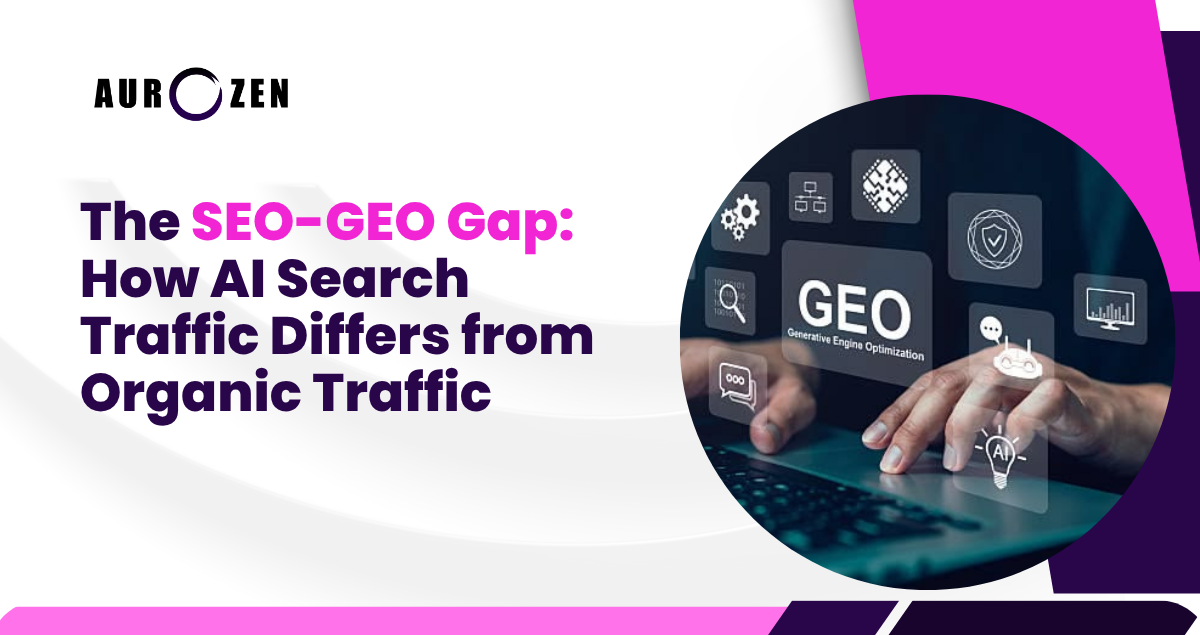
The SEO-GEO Gap: How AI Search Traffic Differs from Organic Traffic
If you recognize that your web page traffic is shifting even though search rankings haven’t changed, maybe it is time to reconsider your strategy. You are not alone. Artificial Intelligence (AI)-driven search experiences are transforming internet search.AI-driven search experiences are changing the way people find information online. AI search platforms play a role in finding answers, assessing brands and ultimately designating them for purchase, while traditional SEO continues to produce significant organic traffic.
With the recent explosion in traffic volume within the sector of search engine marketing as powered by AI, one of the most important and talked-about topics over the past several weeks to months is the SEO-GEO gap, distinguishing AI search traffic from organic traffic. As platforms like ChatGPT, Google AI Overviews, Perplexity, and other generative search engines come on the market with different behaviors, it is essential that businesses know the different ways that each of these behaves. Conventional methods of search engine marketing may not work in AI.
To remain competitive, it’s important to know the distinction between organic and AI-driven search traffic. More relevantly, one has to know how to optimize content for both. In this guide, you will learn what exactly the SEO-GEO gap is: what the key differences are and how you can use these strategies now.
The Difference Between SEO and GEO
Let’s first clarify the concepts of SEO & GEO. It’s easier to understand the gap between SEO & GEO once you define each concept.
It’s no surprise that an optimization strategy is called “Search Engine Optimization” and that it deals with increased visibility in traditional search engines. With SEO, your pages can show up nearer the top of search results pages, leading to more natural website traffic. The idea is to entice visitors to visit your website.
Generative Engine Optimization (GEO) is about optimizing your content to be more visible in AI-generated answers. Instead of bidding for blue links, GEO lays the groundwork for your content for AI systems to reference as an answer source. This ensures that your brand becomes part of the content generated by AI, which increases the chances of showcasing your products or services.
While there are some basic tips that SEO and GEO share, their base principles are intended to reach different kinds of engagements. For this reason, marketers need to change their tactics to respond to changing search behavior.
The SEO-GEO Gap
AI Search vs Organic Search: Key Differences in Traffic and Visibility
The difference between AI-driven traffic in search engines and organic traffic can be summarized as user intent, content consumption, and referral.
Traditional search engines display a list of links for users. Users ‘scan’ options, ‘crawl’ for similar sources, and click the one that appears to be most relevant. While this is the case, AI search engines will often offer concrete responses. Users don’t have to go to several websites to get summarized information.
This change in traffic is significantly altering the Internet traffic flow. GEO prioritizes showing up in AI responses, building authority, and gaining visibility, a contrasted approach from the traditional emphasis on clicks and rankings.GEO is about showing up in AI answers, gaining authority, and being included, matters that are distinct from the old SEO emphasis on clicks and rankings.
With the increase in the adoption of AI search, it is essential that businesses are aware of these differences to ensure they remain visible and seize new opportunities.
User Behavior Changes in AI Search
One of the most significant distinctions between AI-powered search traffic and organic traffic is in user behavior.
In the case of the search engine, organic search users tend to type in fewer and lower-keyword phrases. Their query can be for “best CRM software” or “how to speed up a website. They scan the results of their search to investigate sources.
AI search user behaviors vary. They often ask detailed conversation questions. For instance, the user could ask, “What is the best CRM Software for a small business that has less than 20 employees and has a limited budget?”
Afterwards, AI systems respond with in-depth answers that put together multiple resources and pieces of information. As a result, customers need to wait less for answers and could potentially save time when scouring numerous websites.
So this conduct causes a major transformation in the way brands reach and engage their audience on the web.
Traffic Quality: AI Search vs Organic Search
Many marketers think that as traffic goes up, the results go up. But traffic quality can be more important than traffic volume when choosing a highway.
Organic search generally gets more people because they click on it straight from the SERP. But these visitors might still be in research mode and not ready for action.
AI search traffic tends to be less but can be more intent. Users often ask for a detailed answer, which means they are interested in your product and ready to buy. Thus, people who visit via a recommendation from an AI are likely to convert more easily.
This is a great opportunity for business organizations that are lead-generation oriented. AI search traffic, even in the case of it being just a fraction of one percent, can have real business impact if done the right way.
How AI Search Changes Click-Through Rates
Click-through rate (CTR) has always been an important SEO standard. Websites invest a lot in making their website appear in blue links so as to improve ranking and gain search engine clicks.
This is a reality that is significantly altered by answers generated with the help of artificial intelligence. Users might need to click on websites less often since there may be answers in the AI interface itself.
This phenomenon gives rise to a “zero-click search” ecology for many experts. There is still a significant portion of traffic through traditional search, but more marketers are finding that AI search is meeting user needs without the need for extra clicks.
That doesn’t mean that visibility isn’t more important when the conditions are there. In fact, brand mentions in AI-generated answers carry even greater value because they position your business as an authoritative and trusted source.
As a result, marketers need to gather the visibility data along with traditional traffic data.
Content Requirements for GEO Success
Content planning is also affected by the SEO-GEO gap.
Old-fashioned search engine optimization usually focuses on keyword optimization, titles, inner links and search intent routing. These continue to be important factors. But AI systems have varying criteria for judging content.
Generative engines are partial to content that is knowledgeable, understandable, trustworthy, and thorough. They direct their search for content that will answer the question at hand and give context to support accurate summarization.
Therefore, keywords should not be the only indication for developing GEO content; instead, complete answers must be given as well.
Create content that answers related questions, provides supporting evidence, and demonstrates genuine expertise.” Moreover, structure is conducive to AI systems grasping and referring to your material better.
The Growing Importance of Authority and Trust
Authority has been an important factor in SEO since the beginning. But its role is much greater than its name might suggest in GEO.
When crafting answers, AI systems have a preference for reliable information sources. They want information that provides knowledge and trustworthiness. As a result, brands that possess potent authority signals can end up posting higher visibility in the answers given by AI.
Build authority by publishing original research, citing credible sources, including expert quotes, demonstrating your expertise, and consistently creating accurate, trustworthy content.
Build a consistent and recognizable brand name that distinguishes your website from competing blogs, increases your visibility in AI-generated summaries, and improves the likelihood that AI platforms will feature your content prominently.
Building authority takes time, but can be great support over time.
Measuring AI Search Traffic Effectively
It’s fairly simple to track traditional organic traffic. Learn analytics ranking, analytics impression, analytics click, analytics conversion platform.
There are also new challenges in measuring AI search traffic. There are a growing number of AI platforms that offer limited referral information. Therefore, marketers must find a way to measure performance other than using this method.
Track search growth for branded pages, referral, direct traffic and mentions on AI platforms. The following signs can help you know if your GEO activities are enhancing visibility.
Also, dedicated AI monitoring tools have been continuously proliferating. These tools provide insights into the frequency of content’s appearance in AI-generated answers.
With the industry progressing, the measurement may vary over time to be more advanced.
SEO and GEO Should Work Together
There’s a group of marketers who think about GEO as an alternative to SEO. This perspective can be misguided and lead to unnecessary risks.
SEO is still a great method of website traffic, and it’ll certainly be one of the core digital marketing strategies for a while. Meanwhile, GEO acts on new business opportunities brought by AI-enabled search.
The best way is a combination of both. GEO adds visibility to the generative search experience, and strong SEO contributes to discovering and developing authority.
By combining SEO and GEO, you will exponentially increase the route users have towards your brand. This integrated approach will enhance resilience in the ever-changing landscape of search technology.
Companies who take time to invest in both will set themselves up for long-term success.
Practical Steps to Close the SEO-GEO Gap
The SEO/geo gap needs to be addressed.
Start by reviewing your existing content. Look at ways to be more informative in answering questions and better balancing topical coverage. Tailor content to show knowledge and make it accessible.
Then increase the strength of your authority signals. Share original views, display industry knowledge and provide information on all digital platforms seamlessly.
Another optimization principle is to structure content. Organize ideas and explain in brief and descriptive titles, phrases, and sentences. These enhancements benefit not just search engines and AI systems, but they also boost your visibility.
Also keep an eye on new AI search platforms as they arise. Learning how such sites link content means you can make decisions to have a different strategy before your rivals do.
Companies that step ahead and chart their course in current responses will secure an early competitive edge in this fast-moving scenario.
Looking forward to constructing and protecting a digital marketing roadmap for the future? Schedule a complimentary consultation today and learn how AI search optimization can help your business thrive in the next generation of search.
To not miss out on high-intent visitors, you must avoid risk and have the cash and good intent on hand. To not risk and without cash and good intent, you do not capture high-intent visitors. Start today and create a successful SEO and GEO plan that will yield results.
Conclusion
One major difference between online AI search traffic and organic search traffic is the way that humans are searching online. One major shift in how people search online becomes clear when you examine The SEO-GEO Gap: How AI Search Traffic Differs from Organic Traffic. AI search technology offers new opportunities and challenges for marketers, alongside traditional SEO methods that are essential for creating organic leads.
Spending habits, content preferences and who the content is about are all going to become different with AI search. Those businesses that use SEO in conjunction with GEO can experience better visibility, authority and quality visitors.
The early bird wins the show when it comes to adaptation. With conventional SEO, you can leverage all of the reach possible, both through conventional search and AI-powered. Save time today, improve your online presence, and ensure your business’s future in the evolving search landscape.
Related Posts :